

From the Other Side of the Table
A director on what respectful candor actually sounds like.
By Lisa Anne Thompson Taylor, Founding Partner
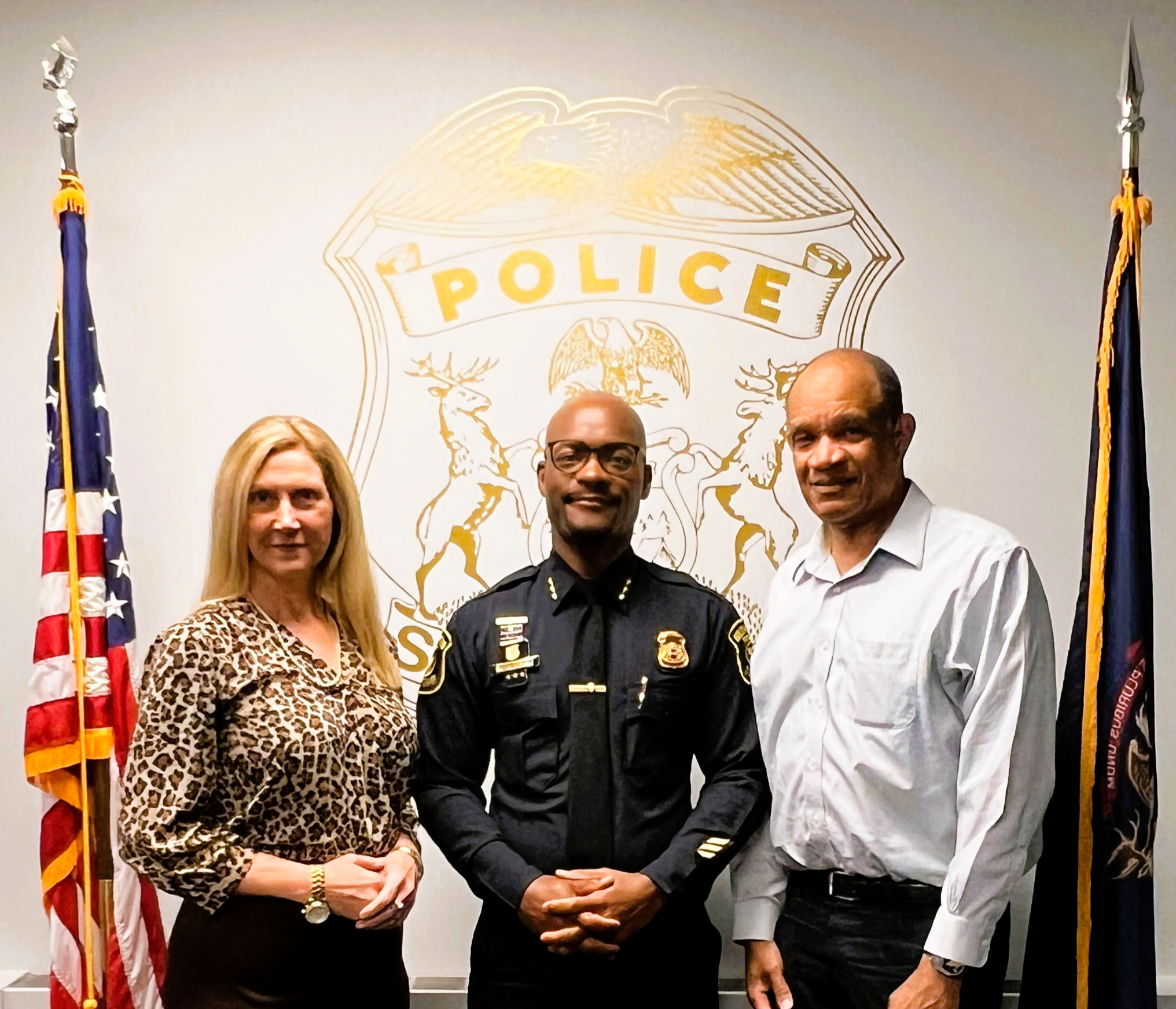
(L-R) Lisa Anne Thompson Taylor, Aaron Huguely, and Chris Morris
The book on my desk right now is Max Bazerman's The Power of Noticing: What the Best Leaders See. The premise, on the back jacket, is about breaking bad habits and spotting the hidden details that change your decision-making for the better. I've been working through it slowly, thinking about how broadly the argument applies to nonprofit boards.
I was describing the premise to Aaron Huguley while visiting his office the other day when it occurred to me, mid-sentence, that noticing is exactly the skill his profession demands. Aaron is the Deputy Chief of Police for Southfield, Michigan. The discipline of seeing what is in front of you — what is present, what is missing, what is off in a way you can't yet articulate — is not an enrichment skill in his work. It is closer to a survival skill. It is also the skill, he and I agree, that produces good directors.
He is also on the board of directors of Orchards Children's Services, a Michigan child welfare organization. So, I asked him three questions about board service. What I got back was a small piece of governance writing in its own right, delivered from a chair we don't usually hear from in this work. His answers are below in full. I'll get out of the way where I can.
On arriving
For all my new board members out there. Being a first-time board member can be overwhelming at first and I would say is akin to moving to another country. Everything is new: the people, the location, the language, the culture, etc. However, with invested effort one can learn the people, the language, the culture, the rules, and the overall mission of the organization. When the information overload gets real, remind yourself that you are there to selflessly serve and that all those tenured and knowledgeable board members seated around the table was once in your "chair."
Most board orientations teach the bylaws. Few teach the language. Aaron names something every new director knows in their body and almost no one says out loud: the first six months are spent translating. Not the financials, though those too. The norms. Who speaks first. Which silences are agreement and which are disagreement waiting.
The room is not made of people who arrive knowing how to do this. It's made of people who learned.
On where the hours go
There are many things one can do with their free time. A few examples may be playing golf or perfecting your skills as a musician, which trust me, I do. However, there is no better use of my free time than serving on the board of a non-profit! I have birdied a hole or two in my day and played a few notes with the correct rhythm, but it does not compare to giving my time to help make the lives of young people and their families better!
Aaron is naming the trade. Golf and music produce something measurable in an afternoon. Board service, at an organization like Orchards Children's Services, produces something that compounds over years — a child placed with the right family, a parent who keeps custody, a teenager who transitions out with somewhere to land. The returns are real. They're just on a longer clock than a scorecard.
On flexing the leadership muscle
There will not always be agreement amongst board members and honestly there should not be, at least at first. We all come from different walks of life, both personally and professionally. During these different walks we have all seen different sights that we call perspectives. It's in true service to the board and the organization that we must present those perspectives to get the best out of our colleagues. It is important to challenge one another, not maliciously but in a respectful manner. The old adage goes "challenge the message not the messenger." If done correctly, the benefits could prove immeasurable for the culture of the board. I say this with experience, as in times past I had to diplomatically remind a board member that the answers to their questions were thoroughly covered in the pre-reads provided over a week prior to the board meeting. This is where trust is born and the overall board will appreciate you leading in this fashion, including the board member in question, as they will be better prepared in the future.
This is the answer I keep going back to.
I've written elsewhere about naming the dynamic, not the person. Aaron has the same idea, in his own words, as challenge the message, not the messenger. I don't think he got it from a governance text. He got it from a career where the cost of getting that distinction wrong is higher than meeting awkwardness.
The pre-reads example is the part I'd ask any new director to study. A fellow board member asks a question that was answered in materials sent a week ago. You can let it go, which teaches the room the pre-reads are optional. You can answer it, which rewards the not-reading. You can rebuke, which costs you and gains nothing. Or you can do what Aaron describes: redirect to the pre-reads, in a way that names what happened without naming the person as a failure.
"This is where trust is born," he says. The formulation is more precise than most governance writing on the topic. Trust is not a feeling that develops over time. It's a specific outcome of specific behaviors, repeated.
Closing
Noticing is the precondition for everything else a leader does on a board. You can't address a constraint you haven't noticed. You can't raise a concern you haven't seen. You can't separate the message from the messenger if you haven't noticed they're being conflated.
But noticing is the easy part. Most directors have noticed something they didn't say. The harder thing is naming it in the room, knowing there will be a price for doing so — sometimes a small one, sometimes not. A reputation shifts. A relationship cools. The matter may escalate. The director who decides to speak knows this and speaks anyway.
The truth budget of a board is set by directors willing to pay that price. Aaron does this quietly. The room is sharper for it.
Most of the conversations I have with boards begin with a director or a CEO noticing one thing that didn't quite sit right. If that is where you are, that is usually where we start.
Directors: What did you bring into your board service from somewhere else that turned out to matter more than you expected?
Let’s have a conversation: schedule an appointment.

— Lisa Anne Thompson Taylor
Managing Partner & Transformation Architect